5 min read
HR leaders rarely lack intuition about what is going wrong in the organisation. They know where recruiting slows down, where leadership quality varies, where important skills are missing, where succession plans look good on paper but fail in practice, and where performance management does not create the expected lift.
The real challenge is different: most people-related problems are still discussed without a credible price tag. And without a price tag, they compete badly against topics that arrive in management meetings with hard numbers, financial consequences and clear investment logic.
No number, no budget
This is not new. What is new is that every other function now arrives at the budget discussion with a number of its own. No number-based argument, no positive budget decision. So the next normal in HR decision-making must be more than better reporting. It must be the ability to predict and quantify business impact. HR Business Partners will be expected to consult, challenge and prioritise, not simply describe what has happened. They will need to show what a people issue costs, what the potential value of improving it could be, and where management should invest first.
The barrier has rarely been willingness. It has been the absence of a method that produces a defensible number in minutes rather than weeks. This is where an Impact Calculator changes the conversation. Instead of asking management to believe in the importance of a people topic, HR can translate the topic into financial terms using the organisation’s own numbers. Suddenly, the discussion moves from “this feels important” to “this is the value at stake”.

Why this matters now
In many companies, people cost represents one of the largest parts of operating expenditure. Yet people management is often still governed by a combination of experience, internal politics, annual cycles and fragmented data. The result is not necessarily bad decisions, but it is often unclear whether the best decisions are being made first.
Classic HR analytics can create transparency. But transparency alone does not automatically create action. A dashboard may show that early turnover is too high, succession pool utilisation is below target, or leadership quality differs across business units. Useful? Yes. Decisive? Not always.
Business leaders have a simple follow-up question: what does it cost us? If HR cannot answer that question, prioritisation becomes difficult. If HR can answer it credibly, the dialogue with line management changes immediately.
From gut feeling to financial impact
The Impact Calculator is designed to help HR put a monetary value on people-related topics. It works with the numbers the organisation already has and turns deviations from targets into business impact. The logic is simple on the surface and solid underneath: enter the situation, define how many people are affected, compare the current state with the target state, and calculate the financial implication in seconds.
That makes the tool especially powerful in conversations where HR must decide what to prioritise and what to park. Recruiting bottlenecks, onboarding speed, leadership quality, skills gaps, performance management, talent mobility and succession planning all become comparable in business terms. The question is no longer only “is this an HR issue?” but “how much value is currently being lost and how much could be recovered?”
Two examples that change the discussion
Business case
Performance management
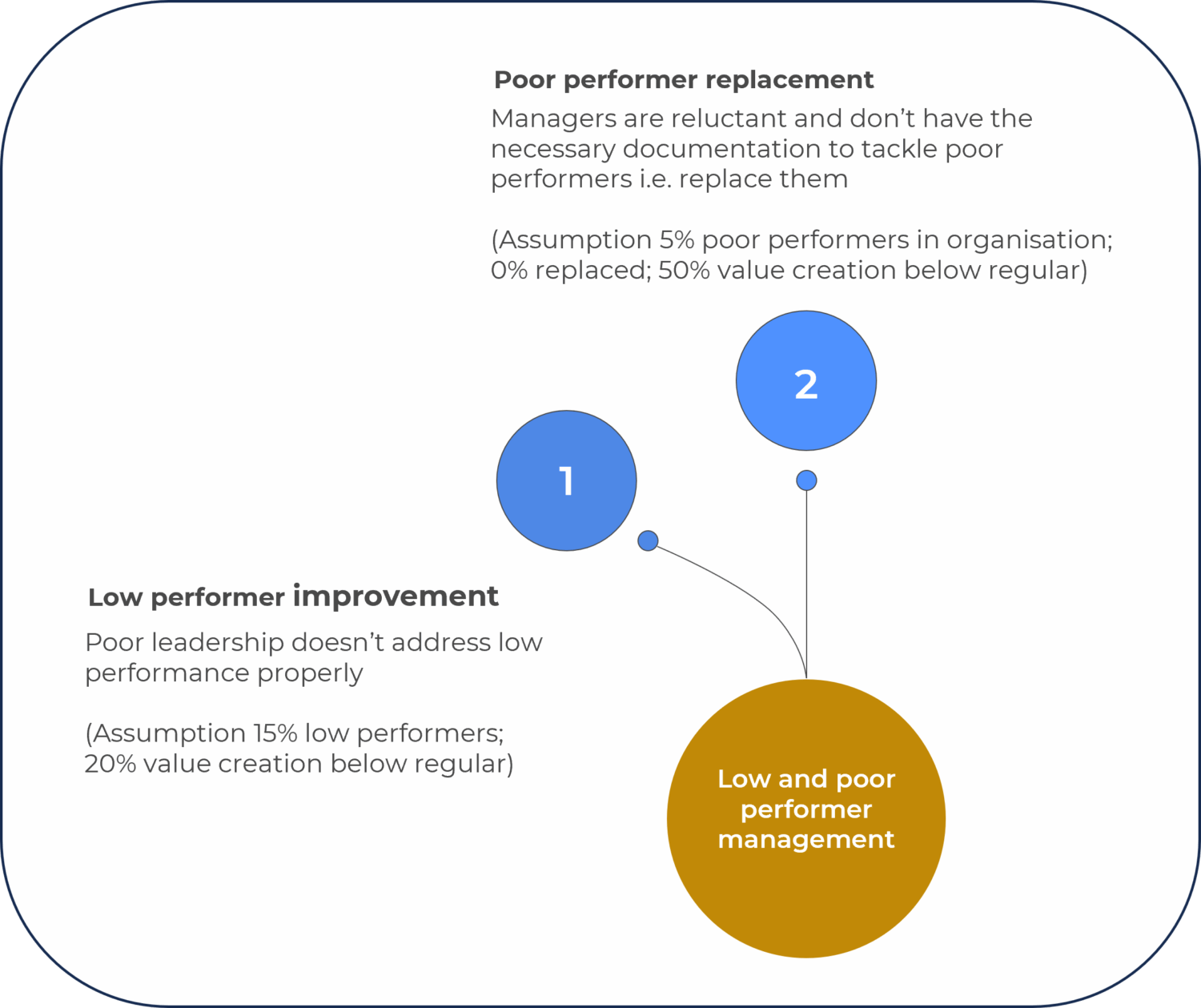
Consider performance management in an organisation with 10,000 employees and 1,000 managers. If only one third of low performers are improved instead of the target of two thirds, and poor performers are not replaced as planned, the financial impact can reach €56 million.
The assumptions behind: People cost €80,000 per employee, people cost 50% of operating expenditure, 15% low performers and 5% poor performers.
That number moves the topic out of the soft category and into a business-critical discussion.
Business case
Successor pool utilisation
Or take successor pool utilisation. In a population of 1,000 managers and 1,500 specialists, underutilising the succession pool, for example achieving 50% utilisation against a target of 85% can create a financial impact of around €4.7 million.
The assumptions behind: 70% of managers and 50% of specialists are in scope for succession management, with a 10% annual vacancy rate and the same people cost of €80,000 per employee.
Again, the point is not the exact figure alone. The point is that succession management is no longer a process compliance topic. It becomes a value-creation topic.

Why HR still struggles to price what it knows
Most HR functions have made progress with data. They have dashboards, engagement results, turnover analyses, performance distributions and workforce plans. But many are still caught between two worlds. On one side, they have operational metrics. On the other, business leaders expect investment logic. The missing bridge is monetary impact.
This is also why “working data driven” can be misunderstood. It does not mean producing more data. It means using data to make better business decisions. More reports can actually create more noise if they do not help managers act. The top-performing approach is different: identify what matters, quantify the value at stake, and use that evidence to focus management attention.
For HR Business Partners, this changes the role profoundly. A Business Partner who can say, “We have a leadership issue in this population” may get agreement. A Business Partner who can say, “This leadership issue is likely costing us several million and here is the breakeven point for addressing it” gets a different level of attention.

Simple for users, robust for decision-makers
The best tools in this space are not complicated for the user. They allow HR and line managers to simulate scenarios together: In the numbers HR already has rather than in rates. Not “what if early turnover drops by three percentage points”, but “what happens if 30 of last year’s new hires leave in the first year instead of 60”. What if onboarding takes four weeks instead of eight? What if 20 of 30 vacant leadership positions are filled from the succession pool instead of 12?
At the same time, the methodology underneath must be transparent enough to stand up to scrutiny from finance, controlling and senior management. The calculation should be explainable, defensible and based on the organisation’s own data. No black box. No unnecessary IT dependency. No data sent anywhere.
What it enables
Used well, the Impact Calculator enables three important shifts. First, analytics create transparency where it matters to the business. Second, impact calculations convert deviations from targets into money. Third, HR becomes better equipped to discuss investment, breakeven points and management accountability.
That gives HR and business leaders a common language. It helps create awareness with line management, focus attention on the topics with the largest value at stake, and avoid spreading effort thinly across too many initiatives. In short, it supports the move from people reporting to people value management.
Built on benchmark insight, made practical for the business
The value of an Impact Calculator depends on whether it combines practical usability with credible methodology. F-Top’s approach is built on 25 years of benchmark data from more than 1,500 company units. That matters because it gives HR a stronger basis for interpreting patterns, translating them into financial impact and discussing what good performance should look like.
This is where the difference between a classic approach and a top performer approach becomes visible. Classic HR functions often measure process activity. Top performers measure whether the process creates value. Classic dashboards often describe status. Top performer dashboards help leaders decide.
The user experience must remain simple: define the topic, enter the relevant workforce numbers, compare current performance with the target and see the monetary implication. But the business discussion becomes more sophisticated. Leaders can ask what the potential value is, what it costs not to act, and where scarce investment should go first.
Next steps
For organisations, the first step is often to identify the people topics where the business already senses pain but lacks a financial view. The second step is to calculate the impact with existing data. The third step is to use the result in a real management dialogue, not as an HR argument, but as a business case.
Some companies may also want support in preparing the data basis, shaping a dashboard concept or upskilling HR Business Partners to work more confidently with number-driven conversations. The objective is not to build another reporting layer. The objective is to help HR become a stronger business partner by linking people management to business value.
If you want to see what these numbers would look like for your own organisation, contact Ursula Boehle at Ursula.Boehle@ftop.ch.
